
The Empathy Vacuum
How Algorithms Hollow Out the Human Heart

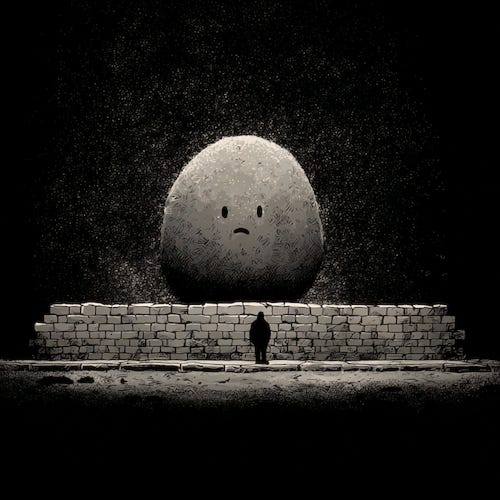
There is a creeping silence growing in the American soul today. It isn’t completely quiet - our feeds still hum, our notifications still chirp - but beneath the noise, something human has gone missing. The connection between us feels more anemic lately. Our voices grow sharper, our tolerance shorter, our capacity to imagine one another’s challenges, weaker. It’s as though we’ve entered a collective trance in which empathy - our most vital social instinct - has been drained from the bloodstream of public life. We once called this compassion. Now, we call it “content”. Studies over the past two decades confirm what our intuition already suspects: empathy is declining. Researchers at the University of Michigan found that college students today show 40% less empathic concern than their counterparts in the 1980s and ’90s. The culprit is not simply self-absorption, but overstimulation. Empathy, like attention, requires stillness - space to notice, to listen, to feel, but we live in an economy that profits from distraction, that feeds on outrage and reward, that gamifies our emotions into metrics of engagement.
In the 1960s, psychologist Stanley Milgram conducted a series of experiments at Yale University that remain among the most chilling portraits of agnostic human behavior. Participants believed they were administering painful electric shocks to another person each time that person answered a question incorrectly. The shocks were fake, but the participants didn’t know that. What Milgram found was unsettling: most people continued to obey the authority figure running the experiment, even as the “victim” screamed in apparent agony. What made this possible was the psychological distance - both physical and moral - between the participant and the person they believed they were harming. The lab coat, the sterile setting, and the absence of direct accountability created a veil of abstraction. Today, the internet functions in a similar way. Social media offers us the illusion of interaction without the cost of intimacy. Behind screens and usernames, empathy dissolves. We can insult, dismiss, and dehumanize others while feeling no immediate consequence, echoing the same dynamic Milgram revealed: when the feedback of pain is removed, cruelty becomes easier, even ordinary. Look no further than the texts just reveiled for a group of young Republicans that show a striking lack of empathy or moral judgement. It has become stylish to be ruthless and uncaring in the world today.
Of course, social media platforms are not neutral mirrors of society; they are factories of influence, designed to keep us reacting. Their algorithms learn us the way a hunter learns prey - tracking our habits, preferences, fears, and desires - until they know exactly what will make us click, argue, or get mad. And the system self-reinforces: the more we react, the more it feeds us reasons to react. Empathy, which thrives in nuance and patience, cannot survive long in such a habitat. Algorithms do not hate us. They do not love us. They optimize us. Their only loyalty is to engagement - the measurable metric of our attention. Outrage, fear, and moral superiority are highly engaging emotions. Subtlety and compassion are not. So our feeds tilt toward extremity, rewarding certainty and shaming doubt. Over time, we become avatars of our own opinions, stripped of complexity, flattened into streams of similar outrage.
The irony is that, as a culture, we are lonelier than ever, even as we are more connected. We scroll through endless online photos and words yet rarely look into each other’s eyes in person. We communicate through reaction emojis - tiny hieroglyphs of feeling that replace the messy, personal work of empathy and true communication. This new shorthand version of communication is extremely limiting and open to misunderstanding. In conversation, empathy asks, what does this person mean? Online, we ask, what does this person represent? Once that shift occurs, the other ceases to be human and becomes a symbolic object. Our senses are also caught in this loop. What we see and hear comes almost entirely through human-generated channels: music playlists, podcasts, videos, posts, and blogs (like this one). Nature’s random harmonies have been replaced by a sort of algorithmic order. The soundscape of empathy (the shared silence of presence) has been drowned out by an infinite chorus of voices clamoring for our attention. We are living in a self-made echo chamber of humanity, detached from the natural world that once tempered our perspective and grounded us in the present. When the only stimuli we experience are crafted by other humans for emotional impact, our empathy narrows. The irony is striking: that we are forgetting how to listen to what doesn’t speak back — the river, the forest, the stillness of another person simply being with us in the present moment — and constantly immersing ourselves in human-generated artifice. Our capacity for genuine connection shrinks to the size of our PC or smart-phone screens. The empathy vacuum is not an accident, it’s a business model. Social platforms discovered that emotional intensity equals profitability. The more polarized the audience, the more active it becomes. Rage keeps people scrolling and outrage keeps them posting. Algorithms have learned to monetize moral fervor by fracturing shared reality. In this new economy, empathy is inefficient. It slows down engagement, complicates narratives, blurs lines that platforms need to keep sharp. The digital marketplace has no patience for ambiguity. So, empathy becomes an endangered resource - rare, unprofitable, and easily drowned in the torrent of sensational content.
Psychologically, constant exposure to emotionally charged content eventually creates desensitization. I have an inside view of the results of living in an insular digital sociey because I have a friend who is a therapist. She is seeing more and more clients that are anxious and exhausted by what they perceive as a world that has gone on without them. Over time and with social conditioning, the human brain learns to adapt by reducing its sensitivity to suffering. This is known as “empathic fatigue” - a phenomenon once observed mainly in caregivers and trauma workers, but now spreading to anyone chronically online. The mind cannot process infinite sorrow or perpetual crisis without defending itself. It numbs itself to survive, and when everything demands outrage, nothing truly moves us. When tragedy becomes just another story in our feed, empathy is replaced by “performance” and a ritualized display of concern that emotionally costs nothing and ultimately changes nothing.
And yet, this story need not end in overwhelming numbness. The vacuum itself reveals what is missing. We still long for connection, authenticity, and the unmediated pulse of shared presence — together. Even as technology isolates us, it also reminds us what we value most - the warmth of a real voice, the pause in a real conversation, the grace of listening without an agenda. Maybe one antidote to algorithmic non-empathy is something very old: proximity. Like looking someone in the eye or sitting across a table without the overpowering urge to respond. In other words, to reclaim the slow rhythm of genuine attention. True empathy does not require agreement; it requires recognition. It begins not in belief, but in awareness. Some technologists now speak of “ethical algorithms” designed to foster understanding rather than division. Others experiment with “empathy prompts” that insert reminders of human complexity into digital discourse. These may help, but the larger work remains internal. The machine cannot teach what we refuse to feel. Empathy, like dialogue, is a living art. It depends on reciprocity, curiosity, and humility. These are the very qualities most absent from online culture. As I wrote about in my previous post, Plato warned us in Phaedrus, that writing might give us the appearance of wisdom without its substance. Perhaps the same is true of our connected age: we have the appearance of empathy without its depth.
The answer to this problem is probably the same as it ever was — conversation. Not the kind that happens in comment threads, but the kind that unfolds in trust and over time. Call it debate or friendship or argument — it is still there in the slow turning toward another person, that we rediscover our shared humanness. The empathy vacuum is not the end of the story - it is the midpoint of an evolution. Technology has shown us what happens when feeling is outsourced to a machine. The next step must be a return to presence, a reintegration of attention and compassion. We cannot delete the algorithms, but we can starve them of our energy. We are being manipulated by our feeds and must decide to impose upon ourselves a healthy boundary. The work of empathy begins in choosing to see reality again. It begins in the smallest gestures, like pausing before reacting, listening before judging, or walking outside to let the world speak to us again in its own language. Because empathy is not just an emotion. It is an act of resistance. It is how we keep the human heart from becoming subsumed inside another algorithm.
Other Relevant Resources on this Subject
Konrath, S., O’Brien, E., & Hsing, C. (2011). “Changes in Dispositional Empathy in American College Students Over Time: A Meta-Analysis.” Personality and Social Psychology Review. Retrieved from Greater Good Science Center
American Psychological Association. “The Decline of Empathy and the Rise of Narcissism.” Speaking of Psychology Podcast. APA.org
Fiske, S. T., & Taylor, S. E. (2023). “Social Drivers and Algorithmic Mechanisms on Digital Media.” Perspectives on Psychological Science. SAGE Journals
Stella, M., Ferrara, E., & De Domenico, M. (2018). “Bots Increase Exposure to Negative and Inflammatory Content in Online Social Systems.” arXiv. arxiv.org
Saveski, M., Gillani, N., Yuan, A., Vijayaraghavan, P., & Roy, D. (2021). “Perspective-Taking to Reduce Affective Polarization on Social Media.” arXiv. arxiv.org
Binns, R., et al. (2024). “The Psychological Impacts of Algorithmic and AI-Driven Social Media on Well-Being.” arXiv preprint. arxiv.org
Guan, Y., et al. (2020). “Social Media Use and Empathy: A Mini Meta-Analysis.” Psychology, Vol. 11(10). scirp.org
Su, L., & Ye, R. (2024). “The Lonely Algorithm Problem: The Relationship Between Algorithmic Personalization and Social Connectedness.” Journal of Computer-Mediated Communication. Oxford Academic
I love the idea of ethical algorithms… just hard to think they will deploy them since rage is such a better engagement tool.